 Fit Habits
The Members You Write Off But Shouldn’t
What the most severe cases at a paralysis recovery center can tell us about members you may have deprioritized.
Most gyms carry a segment of members the staff don’t expect to stay. The list of reasons grows with time but nobody writes them down: the January joiner who never settled into a routine, a member who barely visits and lives on the edge of cancellation. Staff stop learning their names, outreach campaigns pass them by, and attention shifts toward the members who look likely to stay.
Paralysis recovery centers face a similar dilemma with clients managing a complete spinal cord injury. The field expects these clients to just maintain their baseline function, not necessarily improve it. We set out to test this assumption.
The skeptic’s question
Last issue, we published our paper with The Perfect Step®, a neurological recovery center. The study drew on six years of records covering roughly 300 clients; 84 of them had repeated Functional Movement Assessments, forming the longitudinal cohort behind every figure in this issue. Read Participation and Functional Outcomes in Neurological Recovery. Its headline finding was a frequency gradient: clients who trained about nine times a month improved several times faster than clients who trained about three times.
A careful reader will ask the next question immediately. Did the clients who trained more simply have less severe injuries?
Severity shapes everything in this population. A complete injury leaves no motor or sensory function below the level of the injury, while an incomplete injury preserves some. The two groups start from different places and reach different ceilings. If frequency merely tracked severity, the gradient would tell us nothing, so we held severity constant.
Cut one: inside each severity group
Thirty-eight clients in the records carried a severity classification: 30 with incomplete injuries and 8 with complete injuries. We divided each group into a higher-frequency half and a lower-frequency half. If severity explained the frequency effect, the gradient would disappear inside each group, because every client in a comparison shared the same type of injury.
The gradient held in both groups.
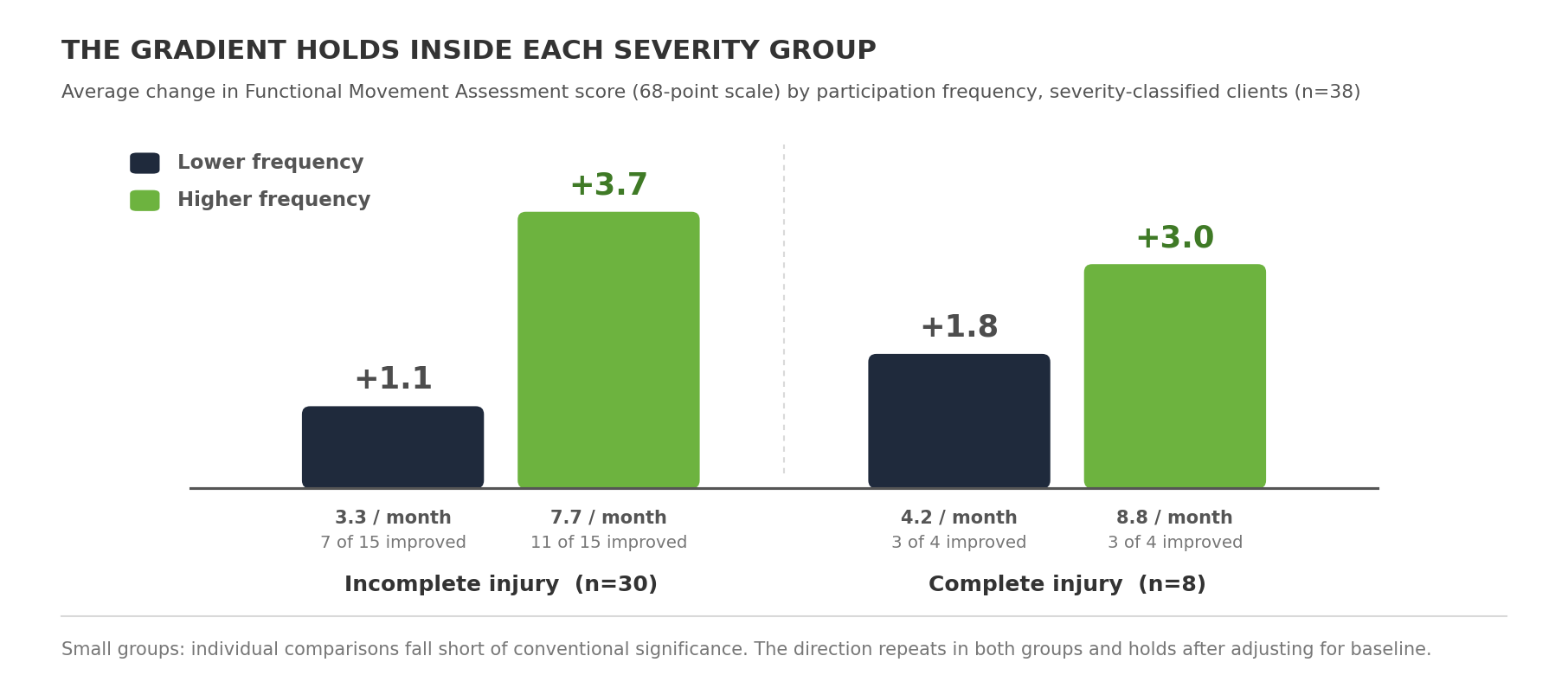
Among clients with incomplete injuries, the higher-frequency half averaged 7.7 sessions a month and gained 3.7 points on the assessment, with 11 of 15 clients (73%) improving. The lower-frequency half averaged 3.3 sessions a month and gained 1.1 points, with 7 of 15 (47%) improving.
Clients with complete injuries, the group with the lowest clinical expectations, showed the same pattern. The higher-frequency half averaged 8.8 sessions a month and gained 3.0 points, while the lower-frequency half averaged 4.2 sessions and gained 1.8. Three of four clients improved in each half.
These sample sizes call for care. Neither comparison reaches conventional statistical significance on its own. The result rests on repetition: the same direction appears in every stratum, and it survives a second, stricter test later in this issue. A finer cut by ASIA grade showed the same direction at every grade with room for improvement, including the most severe.
Frequency is not severity in disguise. The gains did not come from the easiest cases.
Operators can apply the same logic to their own rosters. Every gym holds its own version of the complete-injury group, and the belief that those members won’t respond deserves the same test.
What three points actually mean
A three-point gain on a clinical assessment can look trivial. In this group, it described concrete physical change.
Six clients with complete injuries improved, gaining between 1 and 6 points each and 19 points in total. Seated control accounted for 11 of those 19 points, and five of the six clients improved there. Hands-and-knees positioning and kneeling produced the remaining gains. Walking and assistive-device progression showed no change, as expected.
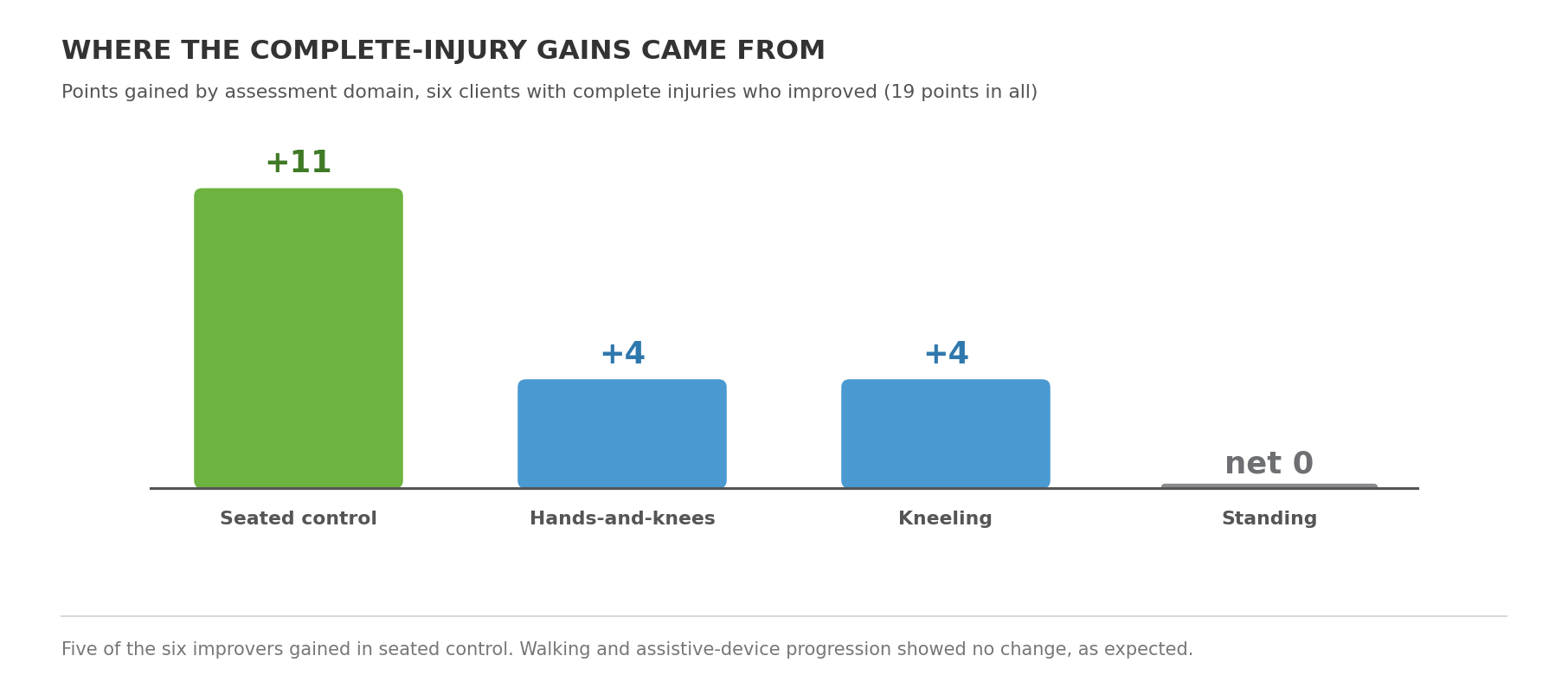
The assessment scores seated control in distinct functional steps. A gain of one to three points moves a person from needing their hands on a table to stay upright, to sitting unsupported with a rounded back, to sitting unsupported with a straight back. Gil Spitz, founder and CEO of Surgical Strong, described the stakes: “That isn’t negligible, it’s the dividing line between dependent 24/7 care and practical independence.”
Membership data behaves the same way. A small measured change inside a written-off segment can decide whether a lapsed member returns or cancels, even when the change barely registers on a dashboard.
Expectations become budgets
Clinicians typically expect clients with complete injuries to hold their current function. The records show something different: under consistent training, these clients continued to make gains.
Operators apply a similar default, and it carries a cost. Once a segment earns a low-potential label, the label shapes the budget. Outreach declines, staff spend less time with those members, and engagement falls in turn. The members then leave on schedule, and the budget decision fulfills the original expectation.
Cut two: did they simply start higher?
After a deeper dive, we found that higher-frequency clients did tend to start with more function. Within the incomplete group, their median baseline score was 14, compared with 5 for the lower-frequency half. Within the complete group, the medians were 19.5 and 10.5. Neither difference reached statistical significance, but the direction warranted a direct test.
By holding baseline function, age, time since injury, and diagnosis constant we found that frequency remained a significant predictor, with each additional monthly session associated with a gain of 1.35 points on the assessment (p = 0.04). The finding survived the second cut.
The same analysis surfaced something unexpected. Across the full cohort, improvement increased with starting function (rho = +0.25, p = 0.02). Clients with the lowest baselines, scores of 0 to 5, still improved 73% of the time, but they gained less, averaging 4.6 points. Clients in the 16–30 band averaged 8.3 points, nearly twice as much.
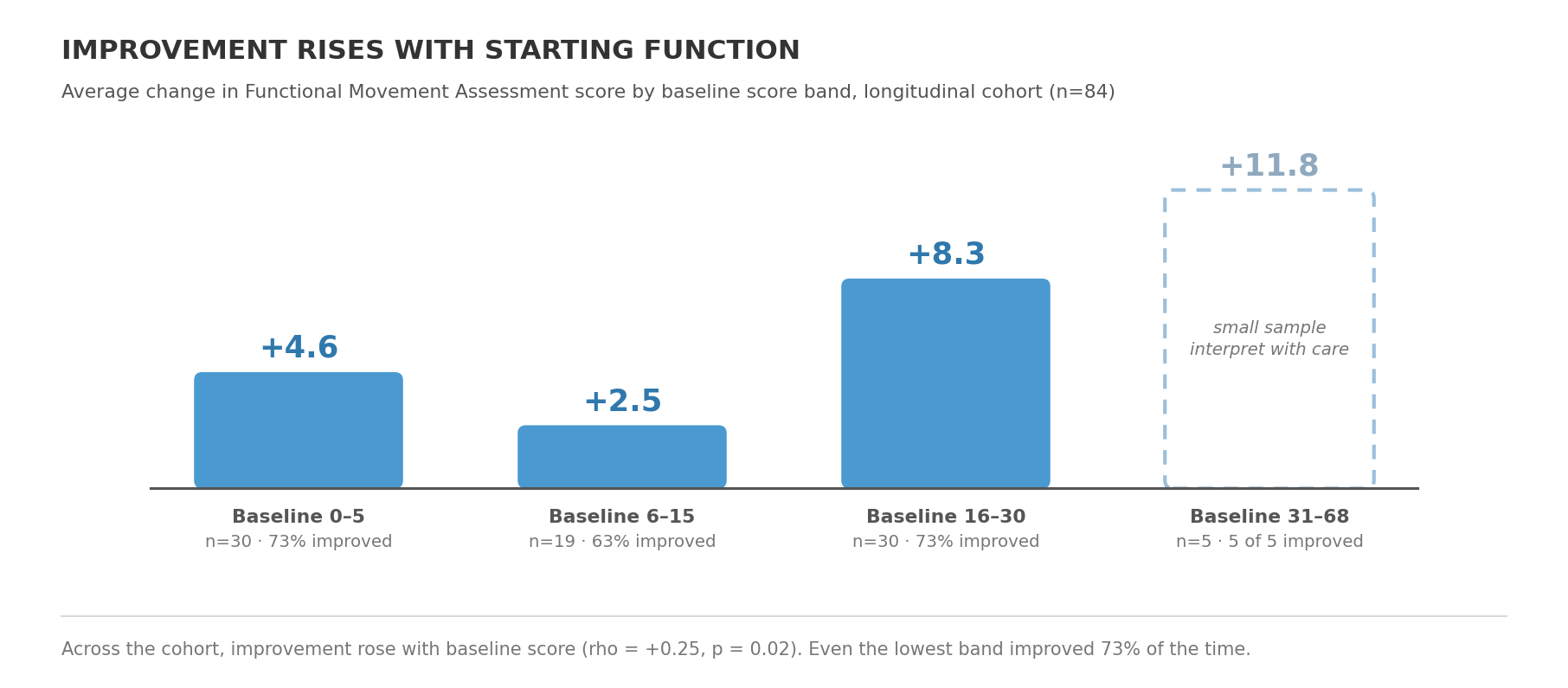
We report this as an observation rather than a mechanism. Existing function appears to give clients a platform for further gains, and very low baselines prove harder to move with lower performance ceilings.
Two issues ago, The Shape of Retention described engagement patterns that look weak but prove strong. This finding belongs in that category, observed this time in a clinical dataset.
It also points operators toward a better vocabulary. Someone assigns potential as a label. Foundation, by contrast, shows up directly in the data: a member who already engages to some degree, keeps some routine, and has some relationship with the facility. Our evidence suggests that while operators should direct their engagement efforts toward capable if not inconsistent members first, ignoring the lowest-engagement members will come at a cost.
Retire the bucket
Engagement reflects how a facility operates, not a fixed trait of its membership. Members that “won’t stick” reflect decisions made in the facility, not observations made in it. Two measures can make them visible: foundation, meaning what a member already does, and frequency, meaning how often they do it.
This week, pull the segment you know you’ve been ignoring and review their actual attendance before you judge anyone’s potential. Then identify the members who show a foundation and an inconsistent schedule, and ask what one more visit a month is worth to them and to your facility.
The field expected the least of clients with complete injuries. Five of the six who improved learned to sit up straighter. Your written-off members likely hold the same capacity, and you simply haven’t cut the data yet.