 Fit Habits
Members Quit Showing Up Before They Cancel, But Not All Of Them…
More than half of a typical gym’s roster pays dues but rarely trains. We call them sleepers. At the gym we studied, they made up four out of five members who churned. And yet most sleepers don’t leave: many come back, and others keep paying without training. We measured the sleepers who left against the ones who stayed to find where the difference shows up, and where retention actually happens.
Setting the stage
We looked at every member who left one independent gym in Texas between March 2 and October 25, 2026, roughly eight months, and at their engagement patterns before they left.
A few terms carry the rest of this issue. A sleeper is a paying member with at most one visit in the trailing 30 days; that is the precise version of “pays dues but rarely trains.” A member left when the membership was cancelled, expired, or went to collections. No surveys, no interviews: everything here comes from the attendance and billing records the gym already keeps.
Who leaves
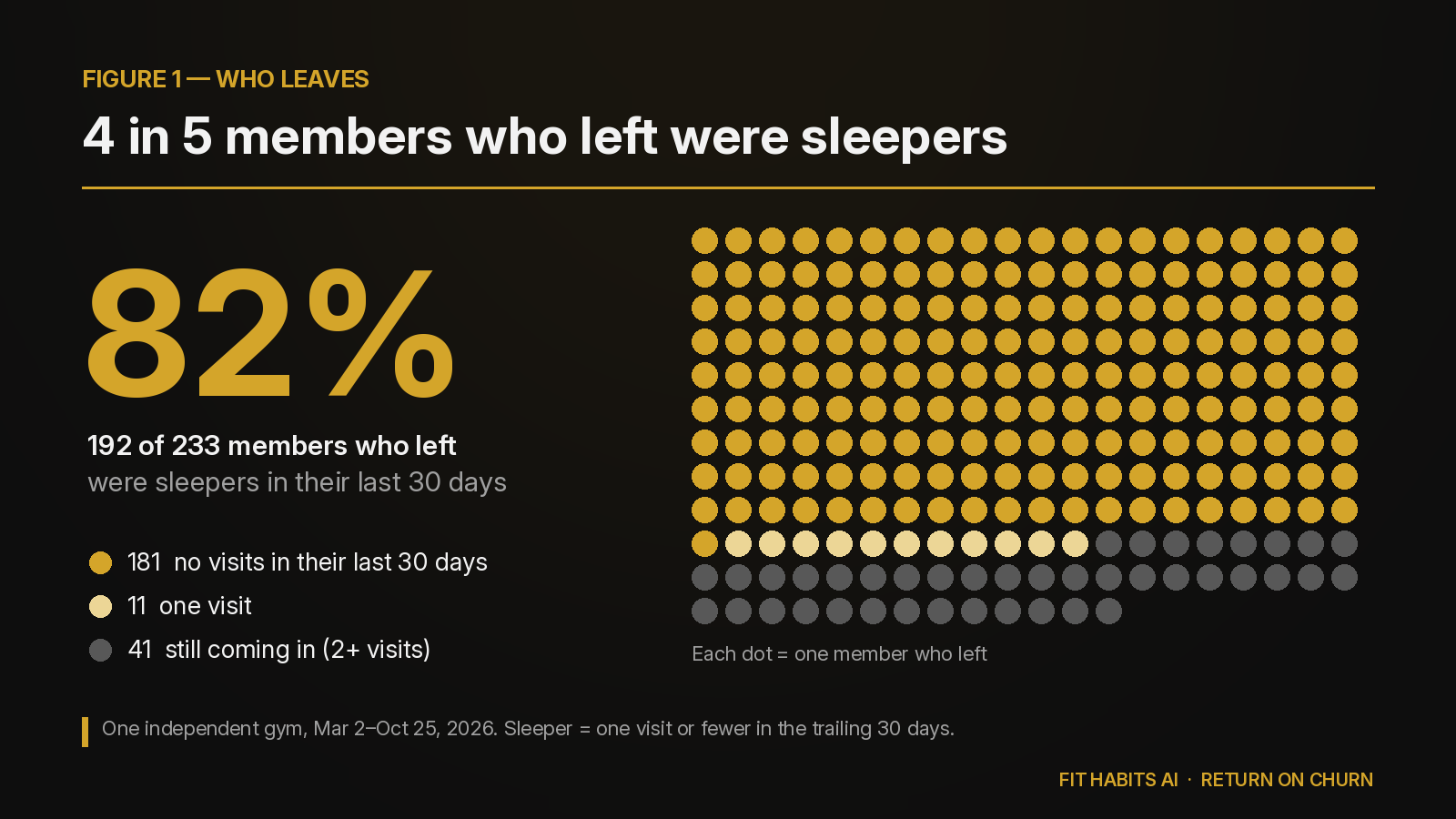
Of the 233 members who left, we found 192 sleepers in their last 30 days, a full 82% of churn. These members didn’t appear to be tapering off either. 181 of the 192, or 78% of all members who left, had no visits at all in their final month. The remaining 18% were still showing up at least twice a month when they left.
That means for most members, actually leaving was the final step of a disengagement pattern preceded by signals in their attendance first. The cancellation paperwork just verified the decision that was already becoming clear.
Earlier this year we published an issue on the 60-day behavioral cliff, showing the engagement drop-off, or the start of dormancy, comes before the billing drop-off, the cancellation. This data puts a number on that order: four in five departures were preceded by dormancy. (Read the cliff issue here)
What happened to the sleepers
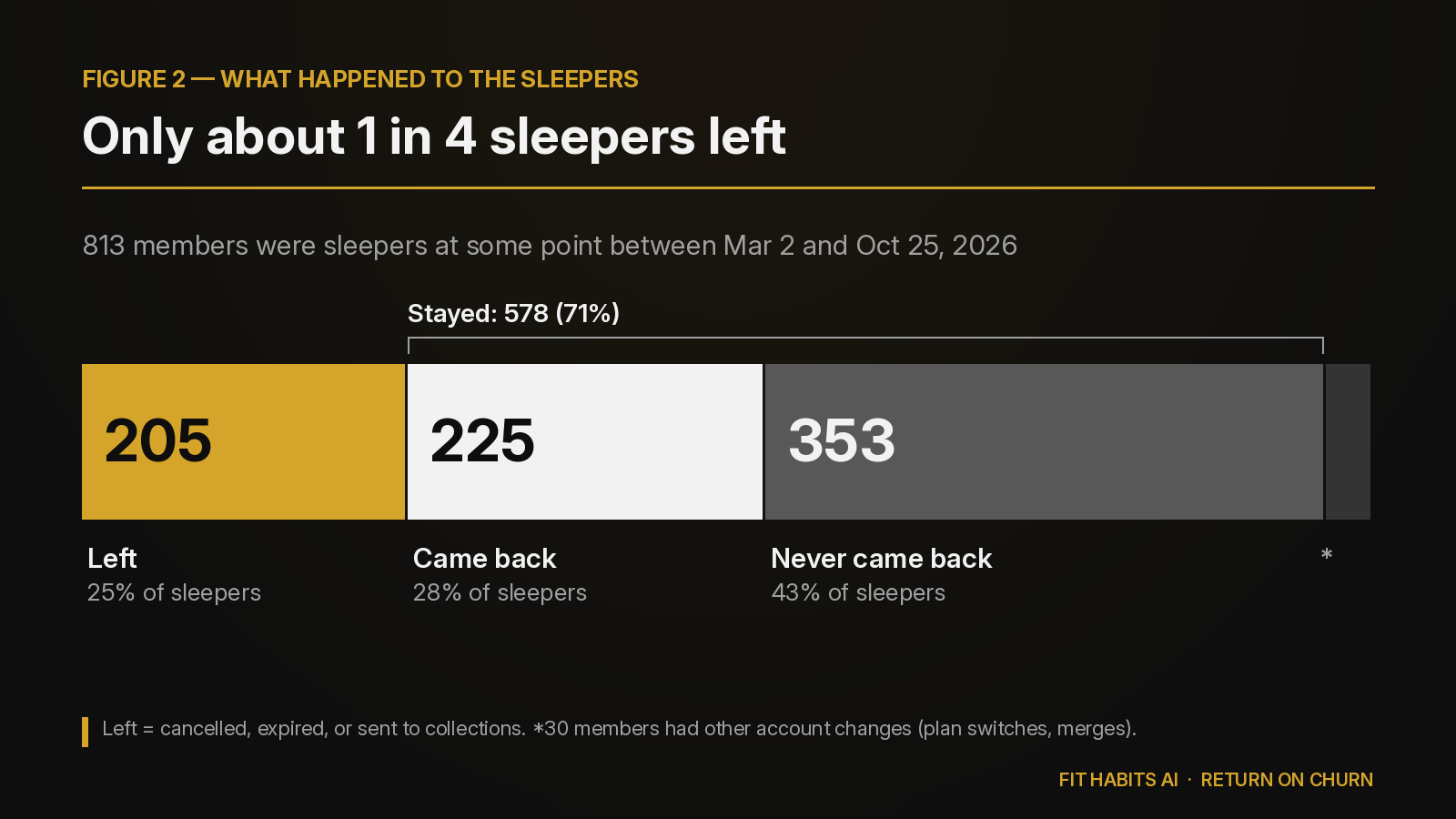
Over the same window, 813 members were sleepers at some point. 205 of them left, about one in four, but 578 of them stayed, more than seven in ten. Of those who stayed, 225 returned to training; 336 were still sleepers when the window closed.
So while sleepers produced most of the gym’s departures, most sleepers didn’t depart, meaning the sleeper pool is far larger than the exit pool. Both facts hold, let’s dive into the tension between them next.
How they left
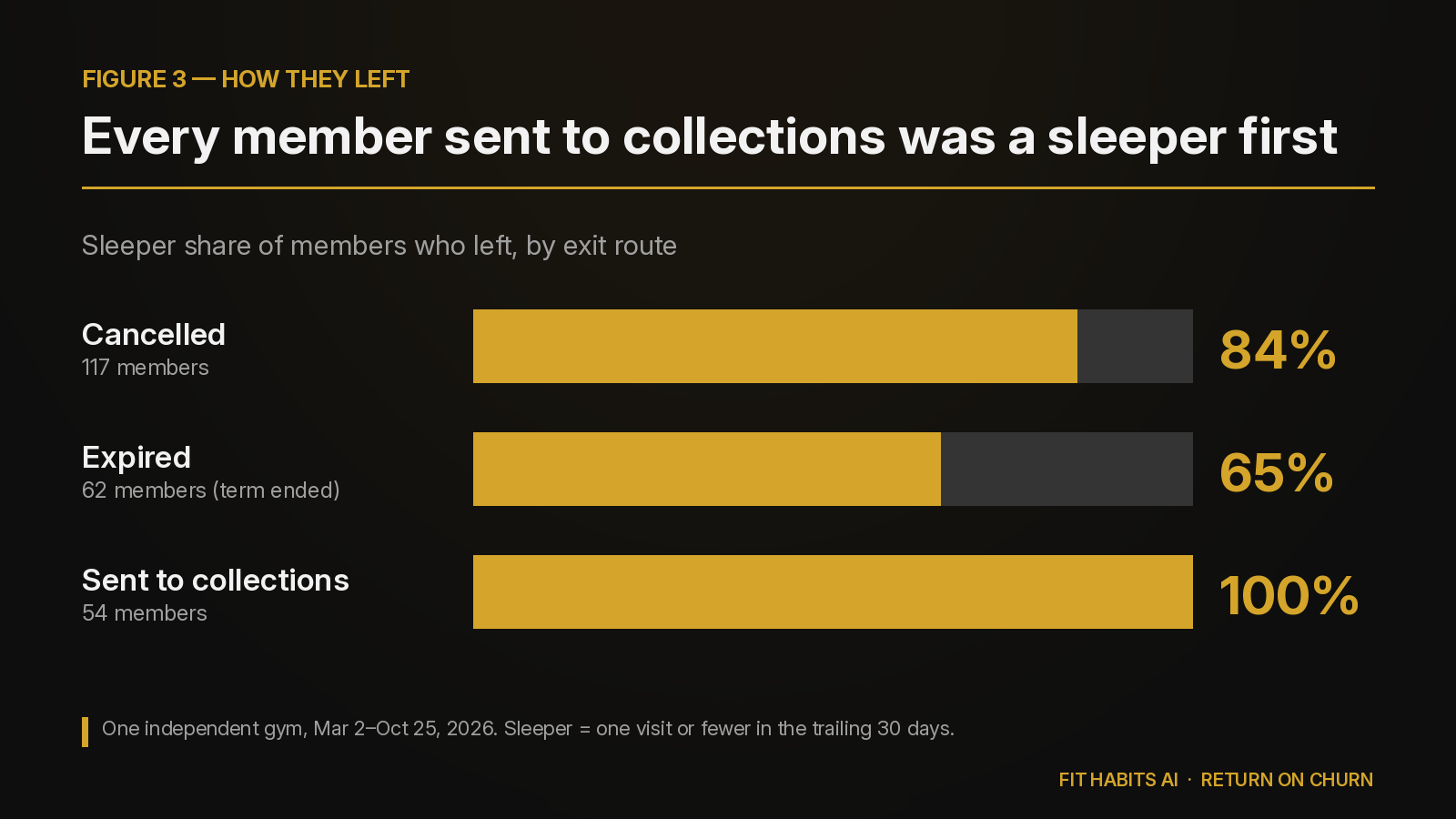
The share of sleepers changes with the exit route. Of the 117 members who cancelled, 84% were sleepers. Of the 62 whose contract term ended, 65% were sleepers. Of the 54 sent to collections, every one was a sleeper.
Collections is entirely a sleeper outcome. Each member who ended up there stopped showing up first. Expiries, the least sleeper-driven exit route, sit at the other end: operators should treat them as more of a renewal question than one of re-engagement.
How long they had been gone
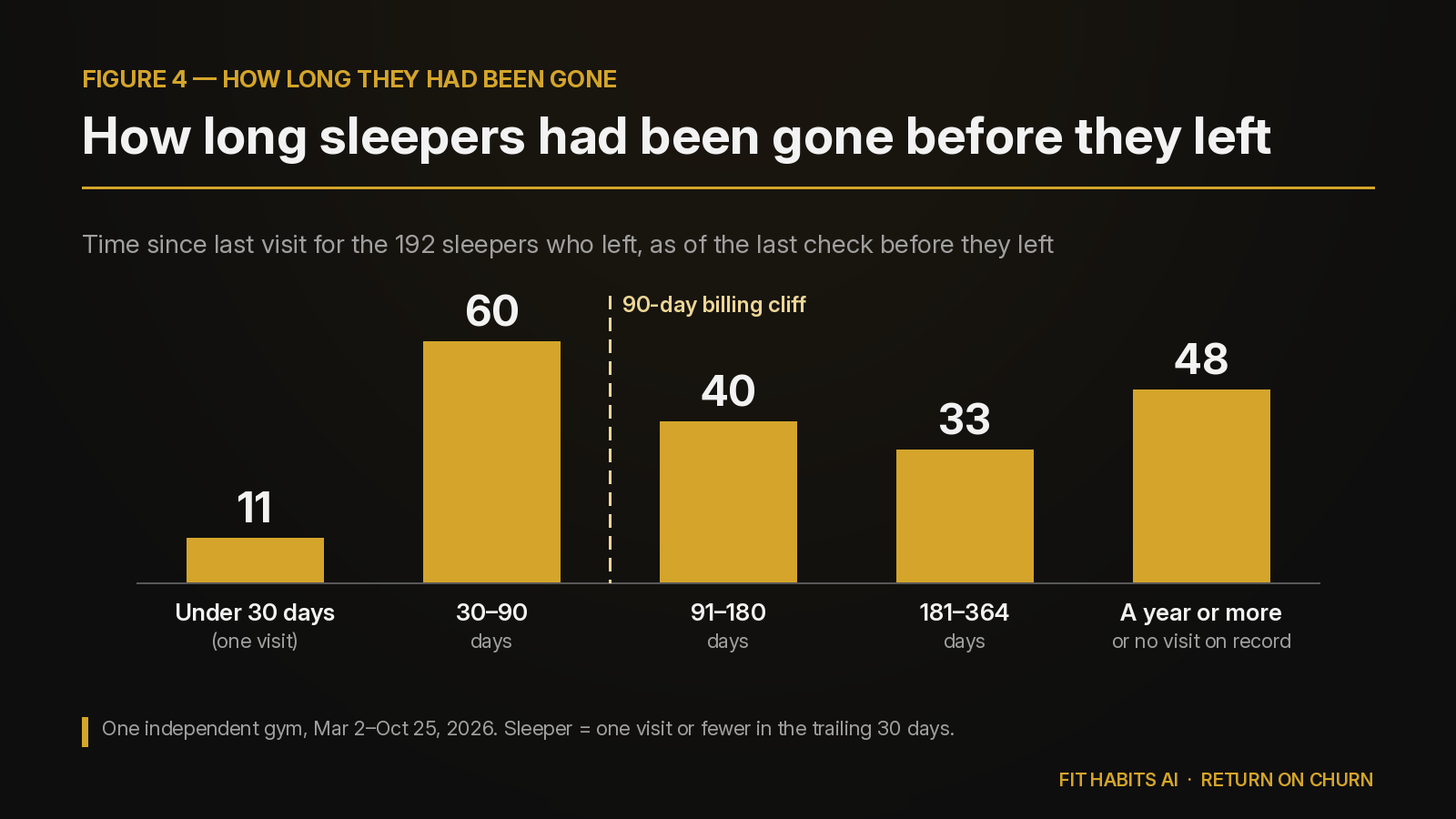
For the 192 sleepers who left, we measured the time since their last visit. 11 were fresh sleepers who visited once within their last 30 days. 60 stopped showing up between the 30 and 90 day mark. 40 had been gone from 91 to 180 days. 33 had quit coming in between 181 and 364 days prior to their last day. And 48 had been gone a year or more, or had no visit on record at all.
The order never changes. Behavioral churn comes first and administrative churn follows, sometimes near the traditional 90-day billing cliff, sometimes much later. Many of these members stayed on the roster for months after they stopped coming.
The one in five who left while still coming in
41 members left the gym while still visiting at least twice a month. About half of them, 22, were memberships reaching the end of their term.
Churn arrives through two channels: members who go quiet first, and members who leave while still coming in. A system that only watches for attendance drops sees the first channel and misses the second. The end-of-term share inside the second channel points to renewal timing.
In an earlier issue we laid out a layered set of models built to catch members at every point in the cycle, from members about to go quiet, to members gone for good, to members drifting while still walking in the door. This data shows why both channels need watching. (Read that issue here to learn why flagging churn risk isn’t just one question)
Most leavers were sleepers. Most sleepers didn’t leave.
About one in four sleepers did leave, but being a sleeper doesn’t tell you which members are about to leave, it tells you where the departures are likely to come from.
The difference showed up the most in our earlier 60-day cliff study, conducted at the same type of facility, where sleepers who returned to training and sleepers who didn’t looked very different before either outcome played out.
While it’s true that members who returned to training had let their routine erode, habit strength fell to about half of their peak, their motivation was still showing strong signals. The routine had weakened; the desire had not.
Members who never returned also never established a routine and showed little to no indicators of motivation. They had never built up their habits in the first place. 88% of them were our “Recruit” archetype, or members still forming a training identity. No “Warriors”, the members with the strongest training identity, failed to come back.
One more observation: 107 members returned to training and then went sleeper again before the window closed. This matches the serial-sleeper pattern from the cliff study and attendance patterns we found in the “Shape of Retention” issue, where member engagement patterns cycle up and down during habit formation.
Treating every sleeper the same misses all of this. The members who will come back, the members who will stay on without training, and the members on their way out look alike on an attendance report. Telling them apart, and sending each one the right intervention, is the work of a decision layer, done from data the gym already collects.
Which of your sleepers are actually leaving?
Churn shows up in attendance before it shows up in billing. The useful question is not “who are my sleepers?” but “which of my sleepers are actually about to leave?”
If you’re an operator, use the data already in your billing system to run these three checks:
- Pull the members who left last quarter and count their visits in the 30 days before they left.
- See how many show an absence for more than 90 days before the cancellation.
- Check how many of the ones still showing up were at the end of their term.
Answering those questions once gives a snapshot. Fit Habits adds the decision layer that does the sorting from your existing data, and sends the right intervention to the right member at the right time.
The cancellation is the last step. The decision was made weeks or months earlier, and we can see it in your data.